
Decision Integrity (DIL) is a research and coaching enterprise working on holistic approaches that benefit sustainable systems, projects, communities, organisations and societies with special emphasis on transformative resilience.

A resilient community is one that takes intentional action to enhance personal and collective capacity to sustain the good life in the context of turbulence and disruption to its optimum living arrangements.
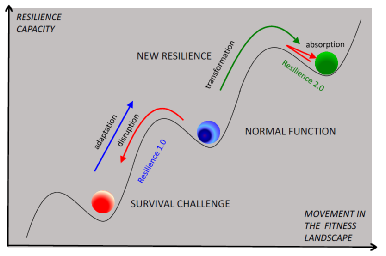
Because the “life as usual” no longer has the degree of resilience required, we need to be clear about levels.
Level 1- Bounce Back is the capacity to recover from disruption back to the “life as usual” level.
Level 2 – Bounce Beyond is the capacity to shift to a new system capable of absorbing and bouncing back from more disruption. This is a new level of adaptive capacity which becomes possible when human communities re-inhabit their specific localities with a new sensitivity to the unique ecological conditions (opportunities and limits) of place.
Transformative resilience is about intelligent, humble, and scale-sensitive co-creation between human communities and the wider ecological communities they inhabit.